
| 10. Cálculo vectorial – Vectores en el espacio | 10.4 El producto cruz |
Ejercicios propuestos para el Capítulo 10.4
Para los siguientes ejercicios, se dan los vectores \(\mathbf{u}\) y \(\mathbf{v}\).
- a. Halle el producto cruz \(\mathbf{u} \times \mathbf{v}\) de los vectores \(\mathbf{u}\) y \(\mathbf{v}\). Exprese la respuesta en forma de componentes.
- b. Bosqueje los vectores \(\mathbf{u}\), \(\mathbf{v}\) y \(\mathbf{u} \times \mathbf{v}\).
183. \(\mathbf{u} = \langle 2, 0, 0 \rangle, \mathbf{v} = \langle 2, 2, 0 \rangle\)
184. \(\mathbf{u} = \langle 3, 2, -1 \rangle, \mathbf{v} = \langle 1, 1, 0 \rangle\)
185. \(\mathbf{u} = 2\mathbf{i} + 3\mathbf{j}, \mathbf{v} = \mathbf{j} + 2\mathbf{k}\)
186. \(\mathbf{u} = 2\mathbf{j} + 3\mathbf{k}, \mathbf{v} = 3\mathbf{i} + \mathbf{k}\)
187. Simplifique \((\mathbf{i} \times \mathbf{i} – 2\mathbf{i} \times \mathbf{j} – 4\mathbf{i} \times \mathbf{k} + 3\mathbf{j} \times \mathbf{k}) \times \mathbf{i}\).
188. Simplifique \(\mathbf{j} \times (\mathbf{k} \times \mathbf{j} + 2\mathbf{j} \times \mathbf{i} – 3\mathbf{j} \times \mathbf{j} + 5\mathbf{i} \times \mathbf{k})\).
En los siguientes ejercicios, se dan los vectores \(\mathbf{u}\) y \(\mathbf{v}\). Halle el vector unitario \(\mathbf{w}\) en la dirección del producto cruz \(\mathbf{u} \times \mathbf{v}\). Exprese su respuesta usando vectores unitarios estándar.
189. \(\mathbf{u} = \langle 3, -1, 2 \rangle, \mathbf{v} = \langle -2, 0, 1 \rangle\)
190. \(\mathbf{u} = \langle 2, 6, 1 \rangle, \mathbf{v} = \langle 3, 0, 1 \rangle\)
191. \(\mathbf{u} = \overrightarrow{AB}, \mathbf{v} = \overrightarrow{AC}\), donde \(A(1, 0, 1), B(1, -1, 3)\) y \(C(0, 0, 5)\)
192. \(\mathbf{u} = \overrightarrow{OP}, \mathbf{v} = \overrightarrow{PQ}\), donde \(P(-1, 1, 0)\) y \(Q(0, 2, 1)\)
193. Determine el número real \(\alpha\) tal que \(\mathbf{u} \times \mathbf{v}\) e \(\mathbf{i}\) sean ortogonales, donde \(\mathbf{u} = 3\mathbf{i} + \mathbf{j} – 5\mathbf{k}\) y \(\mathbf{v} = 4\mathbf{i} – 2\mathbf{j} + \alpha\mathbf{k}\).
194. Muestre que \(\mathbf{u} \times \mathbf{v}\) y \(2\mathbf{i} – 14\mathbf{j} + 2\mathbf{k}\) no pueden ser ortogonales para ningún número real \(\alpha\), donde \(\mathbf{u} = \mathbf{i} + 7\mathbf{j} – \mathbf{k}\) y \(\mathbf{v} = \alpha\mathbf{i} + 5\mathbf{j} + \mathbf{k}\).
195. Muestre que \(\mathbf{u} \times \mathbf{v}\) es ortogonal a \(\mathbf{u} + \mathbf{v}\) y \(\mathbf{u} – \mathbf{v}\), donde \(\mathbf{u}\) y \(\mathbf{v}\) son vectores no nulos.
196. Muestre que \(\mathbf{v} \times \mathbf{u}\) es ortogonal a \((\mathbf{u} \cdot \mathbf{v})(\mathbf{u} + \mathbf{v}) + \mathbf{u}\), donde \(\mathbf{u}\) y \(\mathbf{v}\) son vectores no nulos.
197. Calcule el determinante \(\begin{vmatrix} \mathbf{i} & \mathbf{j} & \mathbf{k} \\ 1 & -1 & 7 \\ 2 & 0 & 3 \end{vmatrix}\).
198. Calcule el determinante \(\begin{vmatrix} \mathbf{i} & \mathbf{j} & \mathbf{k} \\ 0 & 3 & -4 \\ 1 & 6 & -1 \end{vmatrix}\).
Para los siguientes ejercicios, se dan los vectores \(\mathbf{u}\) y \(\mathbf{v}\). Use la notación de determinante para hallar el vector \(\mathbf{w}\) ortogonal a los vectores \(\mathbf{u}\) y \(\mathbf{v}\).
199. \(\mathbf{u} = \langle -1, 0, e^t \rangle, \mathbf{v} = \langle 1, e^{-t}, 0 \rangle\), donde \(t\) es un número real.
200. \(\mathbf{u} = \langle 1, 0, x \rangle, \mathbf{v} = \langle \frac{2}{x}, 1, 0 \rangle\), donde \(x\) es un número real no nulo.
201. Halle el vector \((\mathbf{a} – 2\mathbf{b}) \times \mathbf{c}\), donde \(\mathbf{a} = \begin{vmatrix} \mathbf{i} & \mathbf{j} & \mathbf{k} \\ 2 & -1 & 5 \\ 0 & 1 & 8 \end{vmatrix}, \mathbf{b} = \begin{vmatrix} \mathbf{i} & \mathbf{j} & \mathbf{k} \\ 0 & 1 & 1 \\ 2 & -1 & -2 \end{vmatrix}\) y \(\mathbf{c} = \mathbf{i} + \mathbf{j} + \mathbf{k}\).
202. Halle el vector \(\mathbf{c} \times (\mathbf{a} + 3\mathbf{b})\), donde \(\mathbf{a} = \begin{vmatrix} \mathbf{i} & \mathbf{j} & \mathbf{k} \\ 5 & 0 & 9 \\ 0 & 1 & 0 \end{vmatrix}, \mathbf{b} = \begin{vmatrix} \mathbf{i} & \mathbf{j} & \mathbf{k} \\ 0 & -1 & 1 \\ 7 & 1 & -1 \end{vmatrix}\) y \(\mathbf{c} = \mathbf{i} – \mathbf{k}\).
203. [T] Use el producto cruz \(\mathbf{u} \times \mathbf{v}\) para hallar el ángulo agudo entre los vectores \(\mathbf{u}\) y \(\mathbf{v}\), donde \(\mathbf{u} = \mathbf{i} + 2\mathbf{j}\) y \(\mathbf{v} = \mathbf{i} + \mathbf{k}\). Exprese la respuesta en grados redondeados al entero más cercano.
204. [T] Use el producto cruz \(\mathbf{u} \times \mathbf{v}\) para hallar el ángulo obtuso entre los vectores \(\mathbf{u}\) y \(\mathbf{v}\), donde \(\mathbf{u} = -\mathbf{i} + 3\mathbf{j} + \mathbf{k}\) y \(\mathbf{v} = \mathbf{i} – 2\mathbf{j}\). Exprese la respuesta en grados redondeados al entero más cercano.
205. Use el seno y el coseno del ángulo entre dos vectores no nulos \(\mathbf{u}\) y \(\mathbf{v}\) para demostrar la identidad de Lagrange: \(\|\mathbf{u} \times \mathbf{v}\|^2 = \|\mathbf{u}\|^2 \|\mathbf{v}\|^2 – (\mathbf{u} \cdot \mathbf{v})^2\).
206. Verifique la identidad de Lagrange \(\|\mathbf{u} \times \mathbf{v}\|^2 = \|\mathbf{u}\|^2 \|\mathbf{v}\|^2 – (\mathbf{u} \cdot \mathbf{v})^2\) para los vectores \(\mathbf{u} = -\mathbf{i} + \mathbf{j} – 2\mathbf{k}\) y \(\mathbf{v} = 2\mathbf{i} – \mathbf{j}\).
207. Los vectores no nulos \(\mathbf{u}\) y \(\mathbf{v}\) se llaman colineales si existe un escalar no nulo \(\alpha\) tal que \(\mathbf{v} = \alpha\mathbf{u}\). Demuestre que \(\mathbf{u}\) y \(\mathbf{v}\) son colineales si y solo si \(\mathbf{u} \times \mathbf{v} = \mathbf{0}\).
208. Los vectores no nulos \(\mathbf{u}\) y \(\mathbf{v}\) se llaman colineales si existe un escalar no nulo \(\alpha\) tal que \(\mathbf{v} = \alpha\mathbf{u}\). Demuestre que los vectores \(\overrightarrow{AB}\) y \(\overrightarrow{AC}\) son colineales, donde \(A(4, 1, 0), B(6, 5, -2)\) y \(C(5, 3, -1)\).
209. Halle el área del paralelogramo con lados adyacentes \(\mathbf{u} = \langle 3, 2, 0 \rangle\) y \(\mathbf{v} = \langle 0, 2, 1 \rangle\).
210. Halle el área del paralelogramo con lados adyacentes \(\mathbf{u} = \mathbf{i} + \mathbf{j}\) y \(\mathbf{v} = \mathbf{i} + \mathbf{k}\).
211. Considere los puntos \(A(3, -1, 2), B(2, 1, 5)\) y \(C(1, -2, -2)\).
- a. Halle el área del paralelogramo \(ABCD\) con lados adyacentes \(\overrightarrow{AB}\) y \(\overrightarrow{AC}\).
- b. Halle el área del triángulo \(ABC\).
- c. Halle la distancia desde el punto \(A\) a la línea \(BC\).
212. Considere los puntos \(A(2, -3, 4), B(0, 1, 2)\) y \(C(-1, 2, 0)\).
- a. Halle el área del paralelogramo \(ABCD\) con lados adyacentes \(\overrightarrow{AB}\) y \(\overrightarrow{AC}\).
- b. Halle el área del triángulo \(ABC\).
- c. Halle la distancia desde el punto \(B\) a la línea \(AC\).
En los siguientes ejercicios, se dan los vectores \(\mathbf{u}, \mathbf{v}\) y \(\mathbf{w}\).
- a. Halle el triple producto escalar \(\mathbf{u} \cdot (\mathbf{v} \times \mathbf{w})\).
- b. Halle el volumen del paralelepípedo con las aristas adyacentes \(\mathbf{u}, \mathbf{v}\) y \(\mathbf{w}\).
213. \(\mathbf{u} = \mathbf{i} + \mathbf{j}, \mathbf{v} = \mathbf{j} + \mathbf{k}\) y \(\mathbf{w} = \mathbf{i} + \mathbf{k}\)
214. \(\mathbf{u} = \langle -3, 5, -1 \rangle, \mathbf{v} = \langle 0, 2, -2 \rangle\) y \(\mathbf{w} = \langle 3, 1, 1 \rangle\)
215. Calcule los triples productos escalares \(\mathbf{v} \cdot (\mathbf{u} \times \mathbf{w})\) y \(\mathbf{w} \cdot (\mathbf{u} \times \mathbf{v})\), donde \(\mathbf{u} = \langle 1, 1, 1 \rangle, \mathbf{v} = \langle 7, 6, 9 \rangle\) y \(\mathbf{w} = \langle 4, 2, 7 \rangle\).
216. Calcule los triples productos escalares \(\mathbf{w} \cdot (\mathbf{v} \times \mathbf{u})\) y \(\mathbf{u} \cdot (\mathbf{w} \times \mathbf{v})\), donde \(\mathbf{u} = \langle 4, 2, -1 \rangle, \mathbf{v} = \langle 2, 5, -3 \rangle\) y \(\mathbf{w} = \langle 9, 5, -10 \rangle\).
217. Halle los vectores \(\mathbf{a}, \mathbf{b}\) y \(\mathbf{c}\) con un triple producto escalar dado por el determinante \(\begin{vmatrix} 1 & 2 & 3 \\ 0 & 2 & 5 \\ 8 & 9 & 2 \end{vmatrix}\). Determine su triple producto escalar.
218. El triple producto escalar de los vectores \(\mathbf{a}, \mathbf{b}\) y \(\mathbf{c}\) está dado por el determinante \(\begin{vmatrix} 0 & -2 & 1 \\ 0 & 1 & 4 \\ 1 & -3 & 7 \end{vmatrix}\). Halle el vector \(\mathbf{a} – \mathbf{b} + \mathbf{c}\).
219. Considere el paralelepípedo con aristas \(\overrightarrow{OA}, \overrightarrow{OB}\) y \(\overrightarrow{OC}\), donde \(A(2, 1, 0), B(1, 2, 0)\) y \(C(0, 1, \alpha)\).
- a. Halle el número real \(\alpha > 0\) tal que el volumen del paralelepípedo sea 3 unidades³.
- b. Para \(\alpha = 1\), halle la altura \(h\) desde el vértice \(C\) del paralelepípedo al plano formado por las aristas \(\overrightarrow{OA}\) y \(\overrightarrow{OB}\).
220. Considere los puntos \(A(\alpha, 0, 0), B(0, \beta, 0)\) y \(C(0, 0, \gamma)\), con \(\alpha, \beta\) y \(\gamma\) como números reales positivos.
- a. Determine el volumen del paralelepípedo con lados adyacentes \(\overrightarrow{OA}, \overrightarrow{OB}\) y \(\overrightarrow{OC}\).
- b. Halle el volumen del tetraedro con vértices \(O, A, B\) y \(C\). (Sugerencia: El volumen del tetraedro es \(1/6\) del volumen del paralelepípedo).
- c. Halle la distancia desde el origen al plano determinado por \(A, B\) y \(C\). Bosqueje el paralelepípedo y el tetraedro.
221. Sean \(\mathbf{u}, \mathbf{v}\) y \(\mathbf{w}\) vectores tridimensionales y \(c\) un número real. Demuestre las siguientes propiedades del producto cruz:
- a. \(\mathbf{u} \times \mathbf{u} = \mathbf{0}\)
- b. \(\mathbf{u} \times (\mathbf{v} + \mathbf{w}) = (\mathbf{u} \times \mathbf{v}) + (\mathbf{u} \times \mathbf{w})\)
- c. \(c(\mathbf{u} \times \mathbf{v}) = (c\mathbf{u}) \times \mathbf{v} = \mathbf{u} \times (c\mathbf{v})\)
- d. \(\mathbf{u} \cdot (\mathbf{u} \times \mathbf{v}) = 0\)
222. Muestre que los vectores \(\mathbf{u} = \langle 1, 0, -8 \rangle, \mathbf{v} = \langle 0, 1, 6 \rangle\) y \(\mathbf{w} = \langle -1, 9, 3 \rangle\) satisfacen las siguientes propiedades del producto cruz:
- a. \(\mathbf{u} \times \mathbf{u} = \mathbf{0}\)
- b. \(\mathbf{u} \times (\mathbf{v} + \mathbf{w}) = (\mathbf{u} \times \mathbf{v}) + (\mathbf{u} \times \mathbf{w})\)
- c. \(c(\mathbf{u} \times \mathbf{v}) = (c\mathbf{u}) \times \mathbf{v} = \mathbf{u} \times (c\mathbf{v})\)
- d. \(\mathbf{u} \cdot (\mathbf{u} \times \mathbf{v}) = 0\)
223. Se dice que los vectores no nulos \(\mathbf{u}, \mathbf{v}\) y \(\mathbf{w}\) son linealmente dependientes si uno de los vectores es una combinación lineal de los otros dos. Por ejemplo, existen dos números reales no nulos \(\alpha\) y \(\beta\) tales que \(\mathbf{w} = \alpha\mathbf{u} + \beta\mathbf{v}\). De lo contrario, los vectores se llaman linealmente independientes. Muestre que \(\mathbf{u}, \mathbf{v}\) y \(\mathbf{w}\) son coplanares si y solo si son linealmente dependientes.
224. Considere los vectores \(\mathbf{u} = \langle 1, 4, -7 \rangle, \mathbf{v} = \langle 2, -1, 4 \rangle, \mathbf{w} = \langle 0, -9, 18 \rangle\) y \(\mathbf{p} = \langle 0, -9, 17 \rangle\).
- a. Muestre que \(\mathbf{u}, \mathbf{v}\) y \(\mathbf{w}\) son coplanares usando su triple producto escalar.
- b. Muestre que \(\mathbf{u}, \mathbf{v}\) y \(\mathbf{w}\) son coplanares, usando la definición de que existen dos números reales no nulos \(\alpha\) y \(\beta\) tales que \(\mathbf{w} = \alpha\mathbf{u} + \beta\mathbf{v}\).
- c. Muestre que \(\mathbf{u}, \mathbf{v}\) y \(\mathbf{p}\) son linealmente independientes; es decir, ninguno de los vectores es una combinación lineal de los otros dos.
225. Considere los puntos \(A(0, 0, 2), B(1, 0, 2), C(1, 1, 2)\) y \(D(0, 1, 2)\). ¿Son los vectores \(\overrightarrow{AB}, \overrightarrow{AC}\) y \(\overrightarrow{AD}\) linealmente dependientes (es decir, uno de los vectores es una combinación lineal de los otros dos)?
226. Muestre que los vectores \(\mathbf{i} + \mathbf{j}, \mathbf{i} – \mathbf{j}\) e \(\mathbf{i} + \mathbf{j} + \mathbf{k}\) son linealmente independientes; es decir, no existen dos números reales no nulos \(\alpha\) y \(\beta\) tales que \(\mathbf{i} + \mathbf{j} + \mathbf{k} = \alpha(\mathbf{i} + \mathbf{j}) + \beta(\mathbf{i} – \mathbf{j})\).
227. Sean \(\mathbf{u} = \langle u_1, u_2 \rangle\) y \(\mathbf{v} = \langle v_1, v_2 \rangle\) vectores bidimensionales. El producto cruz de los vectores \(\mathbf{u}\) y \(\mathbf{v}\) no está definido. Sin embargo, si los vectores se consideran como los vectores tridimensionales \(\tilde{\mathbf{u}} = \langle u_1, u_2, 0 \rangle\) y \(\tilde{\mathbf{v}} = \langle v_1, v_2, 0 \rangle\), respectivamente, entonces en este caso podemos definir el producto cruz de \(\tilde{\mathbf{u}}\) y \(\tilde{\mathbf{v}}\). En particular, en notación de determinante, el producto cruz de \(\tilde{\mathbf{u}}\) y \(\tilde{\mathbf{v}}\) está dado por
\[ \tilde{\mathbf{u}} \times \tilde{\mathbf{v}} = \begin{vmatrix} \mathbf{i} & \mathbf{j} & \mathbf{k} \\ u_1 & u_2 & 0 \\ v_1 & v_2 & 0 \end{vmatrix} \]
Use este resultado para calcular \((\mathbf{i} \cos \theta + \mathbf{j} \sin \theta) \times (\mathbf{i} \sin \theta – \mathbf{j} \cos \theta)\), donde \(\theta\) es un número real.
228. Considere los puntos \(P(2, 1), Q(4, 2)\) y \(R(1, 2)\).
- a. Halle el área del triángulo \(P, Q\) y \(R\).
- b. Determine la distancia desde el punto \(R\) a la línea que pasa por \(P\) y \(Q\).
229. Determine un vector de magnitud 10 perpendicular al plano que pasa por el eje \(x\) y el punto \(P(1, 2, 4)\).
230. Determine un vector unitario perpendicular al plano que pasa por el eje \(z\) y el punto \(A(3, 1, -2)\).
231. Considere \(\mathbf{u}\) y \(\mathbf{v}\) dos vectores tridimensionales. Si la magnitud del vector producto cruz \(\mathbf{u} \times \mathbf{v}\) es \(k\) veces mayor que la magnitud del vector \(\mathbf{u}\), muestre que la magnitud de \(\mathbf{v}\) es mayor o igual a \(k\), donde \(k\) es un número natural.
232. [T] Suponga que se conocen las magnitudes de dos vectores no nulos \(\mathbf{u}\) y \(\mathbf{v}\). La función \(f(\theta) = \|\mathbf{u}\| \|\mathbf{v}\| \sin \theta\) define la magnitud del vector producto cruz \(\mathbf{u} \times \mathbf{v}\), donde \(\theta \in [0, \pi]\) es el ángulo entre \(\mathbf{u}\) y \(\mathbf{v}\).
- a. Grafique la función \(f\).
- b. Halle el mínimo y el máximo absoluto de la función \(f\). Interprete los resultados.
- c. Si \(\|\mathbf{u}\| = 5\) y \(\|\mathbf{v}\| = 2\), halle el ángulo entre \(\mathbf{u}\) y \(\mathbf{v}\) si la magnitud de su vector producto cruz es igual a 9.
233. Halle todos los vectores \(\mathbf{w} = \langle w_1, w_2, w_3 \rangle\) que satisfagan la ecuación \(\langle 1, 1, 1 \rangle \times \mathbf{w} = \langle -1, -1, 2 \rangle\).
234. Resuelva la ecuación \(\mathbf{w} \times \langle 1, 0, -1 \rangle = \langle 3, 0, 3 \rangle\), donde \(\mathbf{w} = \langle w_1, w_2, w_3 \rangle\) es un vector no nulo con una magnitud de 3.
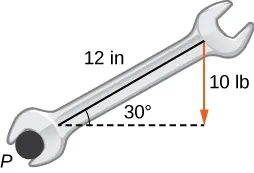
235. [T] Un mecánico usa una llave de 12 pulgadas para girar un perno. La llave forma un ángulo de 30° con la horizontal. Si el mecánico aplica una fuerza vertical de 10 lb en el mango de la llave, ¿cuál es la magnitud del torque en el punto \(P\) (vea la siguiente figura)? Exprese la respuesta en libras-pie redondeada a dos decimales.
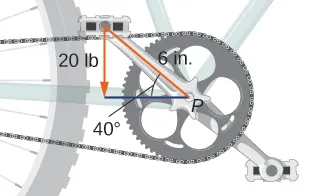
236. [T] Un niño aplica los frenos de una bicicleta aplicando una fuerza hacia abajo de 20 lb en el pedal cuando la biela de 6 pulgadas forma un ángulo de 40° con la horizontal (vea la siguiente figura). Halle el torque en el punto \(P\). Exprese su respuesta en libras-pie redondeada a dos decimales.
237. [T] Halle la magnitud de la fuerza que debe aplicarse al extremo de una llave de 20 cm ubicada en la dirección positiva del eje \(y\), si la fuerza se aplica en la dirección \(\langle 0, 1, -2 \rangle\) y produce un torque de 100 N · m al perno ubicado en el origen.
238. [T] ¿Cuál es la magnitud de la fuerza requerida para aplicarse al extremo de una llave de 1 pie a un ángulo de 35° para producir un torque de 20 lb-pie?
239. [T] El vector de fuerza \(\mathbf{F}\) que actúa sobre un protón con una carga eléctrica de \(1.6 \times 10^{-19} \text{ C}\) (en culombios) que se mueve en un campo magnético \(\mathbf{B}\), donde el vector de velocidad \(\mathbf{v}\) viene dado por \(\mathbf{F} = 1.6 \times 10^{-19} (\mathbf{v} \times \mathbf{B})\) (aquí, \(\mathbf{v}\) se expresa en metros por segundo, \(\mathbf{B}\) está en teslas [T] y \(\mathbf{F}\) está en newtons [N]). Halle la fuerza que actúa sobre un protón que se mueve en el plano \(xy\) a una velocidad \(\mathbf{v} = 10^5 \mathbf{i} + 10^5 \mathbf{j}\) (en metros por segundo) en un campo magnético dado por \(\mathbf{B} = 0.3 \mathbf{j}\).
240. [T] El vector de fuerza \(\mathbf{F}\) que actúa sobre un protón con una carga eléctrica de \(1.6 \times 10^{-19} \text{ C}\) que se mueve en un campo magnético \(\mathbf{B}\), donde el vector de velocidad \(\mathbf{v}\) viene dado por \(\mathbf{F} = 1.6 \times 10^{-19} (\mathbf{v} \times \mathbf{B})\) (aquí, \(\mathbf{v}\) se expresa en metros por segundo, \(\mathbf{B}\) en T y \(\mathbf{F}\) en N). Si la magnitud de la fuerza \(\mathbf{F}\) que actúa sobre un protón es \(5.9 \times 10^{-17} \text{ N}\) y el protón se mueve a una velocidad de 300 m/s en un campo magnético \(\mathbf{B}\) de magnitud 2.4 T, halle el ángulo entre el vector de velocidad \(\mathbf{v}\) del protón y el campo magnético \(\mathbf{B}\). Exprese la respuesta en grados redondeados al entero más cercano.
241. [T] Considere \(\mathbf{r}(t) = \langle \cos t, \sin t, 2t \rangle\) como el vector de posición de una partícula al tiempo \(t \in [0, 30]\), donde las componentes de \(\mathbf{r}\) se expresan en centímetros y el tiempo en segundos. Sea \(\overrightarrow{OP}\) el vector de posición de la partícula después de 1 segundo.
- a. Determine el vector unitario \(\mathbf{B}(t)\) (llamado el vector unitario binormal) que tiene la dirección del vector producto cruz \(\mathbf{v}(t) \times \mathbf{a}(t)\), donde \(\mathbf{v}(t)\) y \(\mathbf{a}(t)\) son el vector de velocidad instantánea y el vector de aceleración de la partícula después de \(t\) segundos, respectivamente.
- b. Use un CAS (sistema de computación algebraica) para visualizar los vectores \(\mathbf{v}(1), \mathbf{a}(1)\) y \(\mathbf{B}(1)\) como vectores que parten del punto \(P\) junto con la trayectoria de la partícula.
242. Un panel solar está montado en el techo de una casa. El panel puede considerarse posicionado en los puntos de coordenadas (en metros) \(A(8, 0, 0), B(8, 18, 0), C(0, 18, 8)\) y \(D(0, 0, 8)\) (vea la siguiente figura).
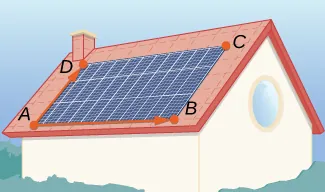
- a. Halle el vector \(\mathbf{n} = \overrightarrow{AB} \times \overrightarrow{AD}\) perpendicular a la superficie de los paneles solares. Exprese la respuesta usando vectores unitarios estándar.
- b. Suponga que el vector unitario \(\mathbf{s} = \frac{1}{\sqrt{3}}\mathbf{i} + \frac{1}{\sqrt{3}}\mathbf{j} + \frac{1}{\sqrt{3}}\mathbf{k}\) apunta hacia el Sol en un momento particular del día y el flujo de energía solar es \(\mathbf{F} = 900\mathbf{s}\) (en vatios por metro cuadrado [\(\text{W/m}^2\)]). Halle la cantidad predicha de potencia eléctrica que el panel puede producir, la cual está dada por el producto punto de los vectores \(\mathbf{F}\) y \(\mathbf{n}\) (expresada en vatios).
- c. Determine el ángulo de elevación del Sol sobre el panel solar. Exprese la respuesta en grados redondeados al número entero más cercano. (Sugerencia: El ángulo entre los vectores \(\mathbf{n}\) y \(\mathbf{s}\) y el ángulo de elevación son complementarios).
Hey there. I found your website via Google at the same time as searching for a related matter, your web site came up. It seems to be good. I have bookmarked it in my google bookmarks to visit then.
Great content! Super high-quality! Keep it up! 🙂